Historic Environment Scotland is the lead public body set up to investigate, care for and promote Scotland’s historic environment.
From brochs, castles and palaces to abbeys, towers and tombs there are over 5000 years’ worth of history for you to enjoy.
Entrance Fees To Iona Abbey
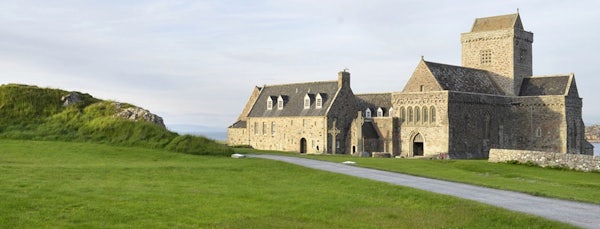
Columba’s fame has brought pilgrims to Iona since the 7th century. Visitors still follow a route similar to the Sràid nam Marbh (‘Street of the Dead’) taken by pilgrims of old. But it now ends at a 13th-century abbey, which stands on the site of Columba’s church.
Four tall, intricately carved crosses, dating from the 8th and 9th centuries, once stood close to the abbey. Three can now be seen in the Abbey Museum, while one is still in place.
Iona was a leading artistic centre from the 8th century, and sculptors, metalworkers and manuscript illuminators flourished here.
The small graveyard of Reilig Odhráin is the final resting place of local clan chieftains and ‘Kings of the Isles’. It has been used as a graveyard into recent times.
When the graveyard was extended in the 1970s, important evidence was found of timber buildings associated with the Columban monastery.
Iona’s spiritual life continues today, through the work of the Iona Community.
Columba’s monastery
The island of Iona seems remote today. But it was at the centre of the life of the Irish Church, as it was easily accessible by boat from mainland Ireland and Scotland. Iona became an internationally renowned centre of spirituality, learning and art.
The only visible remains of Columba’s monastery are:
the great vallum (earthen bank) that enclosed the holy site and which pre-dates the monastery
Tòrr an Aba (‘Hill of the Abbot’) where Columba is said to have had his writing hut
Iona is a rich archaeological landscape, and much more of the early monastery may survive beneath the upstanding remains.
St Columba’s Shrine, a small stone building beside the door to the abbey church, may date from the 9th or 10th century. By this time, Viking raids blighted the coasts of the British Isles, and raids on Columba’s monastery were a frequent occurrence.
A place of pilgrimage
Iona has been an important place of pilgrimage throughout history and remains so today. Its architecture reflects the great political and economic importance of pilgrims: the monastic economy depended on Christians drawn to Iona by the sanctity of St Columba.
SCHEDULE:
1 April to 30 September: Daily
1 October to 31 March: Monday, Tuesday, Wednesday, Thursday, Friday and Saturday
CLOSURES: 25-26/12; 01-02/01;
COMPLIMENTARY POLICY: One free tour leader ticket per group order.
NOTES:
All bookings (FIT’s & Groups) must be pre-booked with timeslot
The Abbey may close at short notice due to weather disruption to the ferry service
Ratios for groups travelling with children: Under 5s (1 adult for every 2 children), Ages 5-7 (1 adult for every 6 children), Ages 8-15 (1 adult for every 10 children).
